


KEY TAKEAWAYS
01
Interest proves relevance, not readiness.
02
The buyer is evaluating the business behind the product.
03
Assurances transfer risk. Plans reduce it.
Large organizations often have good reasons to purchase from smaller and growth-stage companies: specialized expertise, new technology, greater responsiveness, and innovative solutions large suppliers may not provide. Yet while the interest can be entirely genuine, the buyer’s obligations remain.
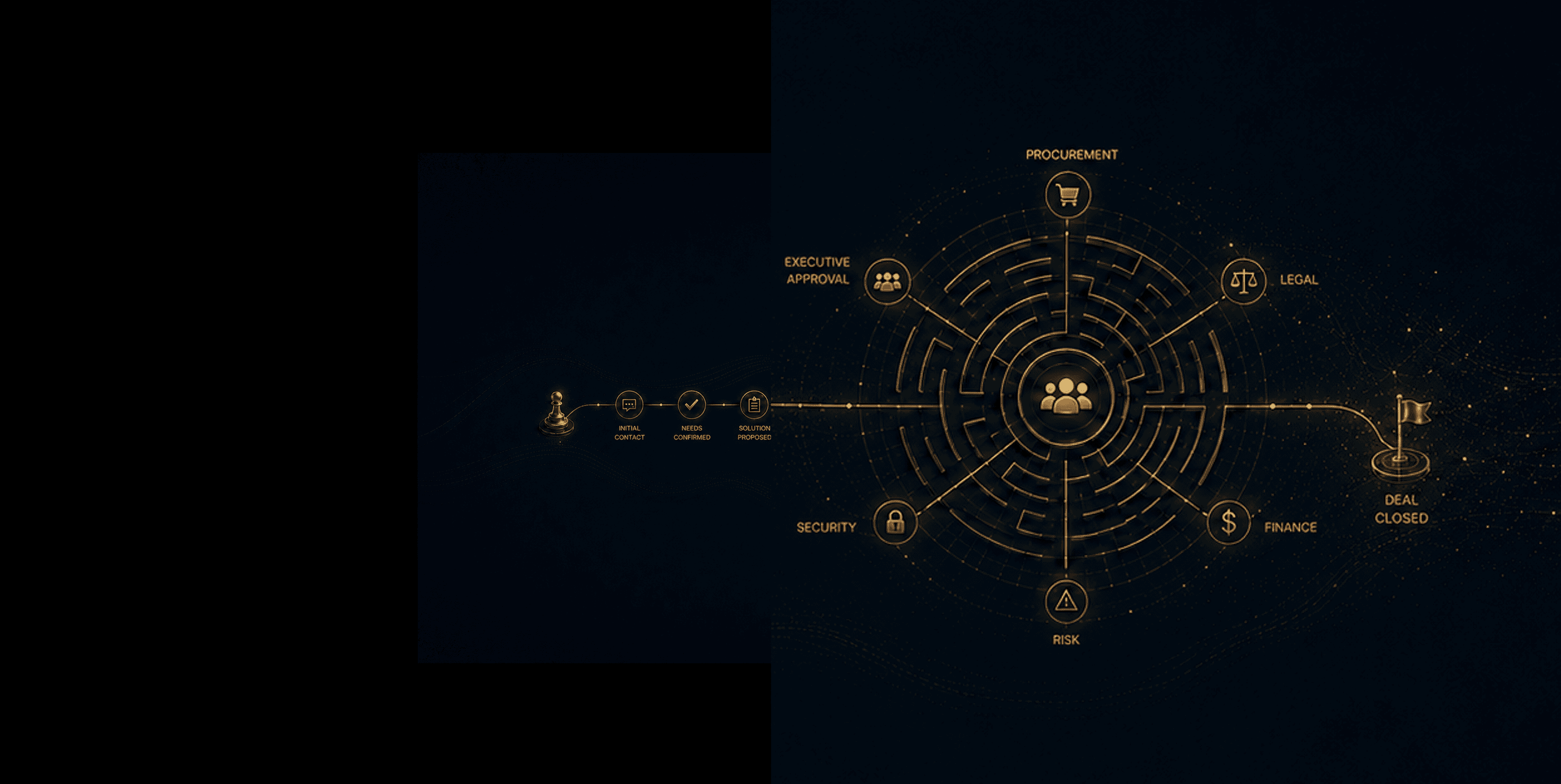
Forrester’s 2024 research found that an average of 13 people are involved in a B2B buying decision, 89% of purchases involve two or more departments and 86% stall during the buying process.²
Those figures help explain why strong interest and a stalled decision are not contradictory. A deal can have an enthusiastic champion and no determined opponent, and still stop moving because the risk posture appears too high. The stall is often cumulative: no single issue is fatal, but each unanswered question adds uncertainty until the decision becomes too difficult to carry.
of the purchase process occurred before seller engagement.¹
people are involved in the average buying decision.²
of B2B purchases stall during the buying process.²
An enterprise cannot suspend its security standards because it likes the product. It cannot bypass procurement because the founder is impressive. It cannot accept unclear liability because the solution is innovative. A promising opportunity therefore becomes a security questionnaire, insurance request, procurement assessment, implementation review and several rounds of redlines—questions raised by people who were not part of the original conversation.
The buyer is not looking for a risk-free supplier. It is looking for evidence that the seller understands the risks it is asking the buyer to accept—and has a credible way to contain them.
Interest changes what is being evaluated.
Before interest, the seller is proving relevance. After interest, the seller is proving readiness.
Growth companies do not always recognize that shift. Early conversations tend to center on the product, the problem and the potential outcome. Once the opportunity becomes real, the buyer begins examining the business behind the product: its controls, financial resilience, delivery capability, service model, technical environment and ability to meet enterprise obligations.
The resulting requests can appear disconnected—a security questionnaire, proof of insurance, compliance credentials, implementation detail, service levels, staffing assumptions or changes to the commercial terms. They are not. Each is part of the same underlying assessment: what will the buyer be exposed to if the seller cannot perform as promised?
Promises do not mitigate risk. Plans do.
Sellers often respond to buyer concern with assurances: security is taken seriously; the team can scale; the required capability is on the roadmap; additional support can be hired once the contract is signed. Those statements may be entirely sincere. They still leave the buyer carrying the risk.
A plan shows what already exists, what still needs to be done, who owns it, when it will be complete, what evidence will demonstrate completion and what happens if an assumption fails.
A cybersecurity company, for example, should know which certifications, independent tests, controls and customer security requirements are likely to matter before diligence begins. If the work is underway, the buyer needs more than a promise to finish it. It needs a defined scope, accountable owner, credible timeline and an interim response to the remaining exposure.
The same applies to delivery. If onboarding and support depend on highly skilled resources, the buyer will want to know what capacity already exists, how those people will be secured in a competitive market, how long hiring and training will take and how service will be protected if recruitment takes longer than expected. “We will hire once the deal closes” is a promise. A resourcing model with triggers, lead times, ownership and contingencies is a plan.
Readiness work falls into three broad areas: evidence that can withstand review; commercial positions that reflect the full cost and risk of participation; and a delivery model that turns commitments into credible execution. The nine areas below are the ones most likely to expose a gap after buyer interest. Hover over—or tap—each card to see what prepared looks like.

Security Controls

Privacy & Data

Compliance Evidence

Contract Readiness

Liability & Insurance

Commercial Model

Implementation & Delivery Plan


Service Continuity
The strongest sellers help the decision travel. They know what finance needs to approve the investment, what security needs to assess exposure, what legal needs to manage liability and what operations needs to commit resources—and they equip the champion before internal scrutiny begins.
The answers do not need to be perfect. They need to be honest, specific and supported by a sequence the buyer can evaluate. Some risks can be closed, some mitigated and some consciously accepted.
Enterprise deal readiness is not the ability to produce a reassuring answer to every buyer question. It is the ability to understand the obligations before the questions arrive—and show a credible path from promise to performance. The enterprise may already want to buy. Seller readiness determines how much work—and how much risk—the organization must absorb to get there.
References
1. 6sense, The 2024 B2B Buyer Experience Report.
2. Forrester, The State of Business Buying, 2024.
